Hey everyone, let’s cut to the chase—if you’ve ever held a smartphone, a laptop, or even a smartwatch, you’ve got tiny tin solder balls to thank for it working. I’m [Name], and I run a tin solder balls supplier, so I’ve spent the last 8 years geeking out over these little (like, seriously tiny—think 0.2mm to 0.5mm, smaller than a grain of sand) metal balls that most people don’t even know exist. But without them, every electronic gadget you use would be dead on arrival, or at best, a useless hunk of plastic and wires. Let’s break down what these things actually do, because I swear, their role in semiconductor packaging is way cooler than it sounds once you dig in. Tin Solder Balls
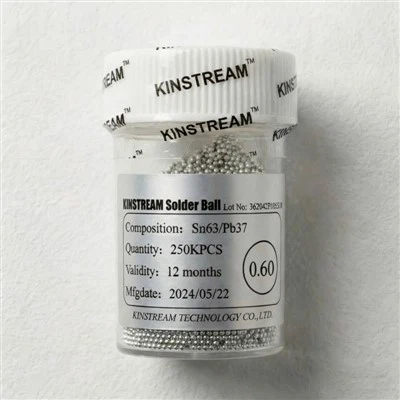
First off, let’s get the basics straight: semiconductor packaging isn’t just slapping a chip in a plastic box. It’s the whole process of connecting that delicate silicon chip (the “brain” of your phone) to the outside world—so it can talk to your screen, battery, or whatever else. Think of a chip as a kid with a million tiny fingers; those fingers need to plug into something that lets them touch other parts of the device, right? That’s where solder balls come in. Specifically, tin solder balls—usually an alloy of tin, sometimes with a little copper, silver, or even lead, but modern ones are mostly lead-free because regulations caught up.
Wait, why tin? Because tin has this perfect balance of low melting point (around 217°C for standard lead-free alloys) and super strong, reliable bonds when it cools. Semiconductors are super sensitive to heat, so you can’t use a solder that needs way too much heat—you’d fry the chip. Tin’s melting point is just high enough to stay solid during normal device use, but low enough to melt cleanly when the chip is being assembled, no damage done.
Now, the main role of tin solder balls is what’s called flip-chip bonding. That’s the big one. If you’ve seen a traditional chip package, it’s the chip wired up with tiny gold threads (wire bonding) that stick out to a lead frame, then encased in plastic. Flip-chip is way different—you flip the chip upside down, so all those tiny contact points (called bumps) on the bottom of the chip line up exactly with matching pads on the package substrate. Then you drop a tin solder ball on each pad, heat the whole thing up, and the balls melt, flow, and solidify into a tight, conductive connection between the chip and the substrate. No messy wires, just direct, super short connections. That’s a game-changer for speed too—less distance for electrical signals to travel means faster gadgets, less lag, even less power used. That’s why your new iPhone or gaming console has flip-chip packages everywhere, and tin solder balls are the key to that.
But that’s not all. They also do heavy lifting in ball grid array (BGA) packages. BGAs are everywhere—PC motherboards, graphics cards, even some smartwatch modules. Instead of the old surface-mount packages with pins along the edges, BGAs have a grid of solder balls on the bottom of the package. So when you mount the BGA to the motherboard, you line up the ball grid with matching pads on the board, melt the solder balls, and boom—hundreds or thousands of connections all at once, evenly spaced. That’s way more connections in less space than edge pins would ever let you have. And because the stress of temperature changes (like when your laptop gets hot) is spread out across all those balls, not just a few pins, the whole package is way less likely to crack or break over time. I’ve had customers tell me their old BGA boards would fail when I replaced their old solder balls with better, higher-tin-content ones—turns out, inferior balls had higher tin-lead ratios that didn’t handle temperature swings as well.
Let’s talk reliability, because that’s the name of the game in semis. A semiconductor package has to last years, even decades, through being dropped, heated, cooled, exposed to humidity—all kinds of crazy conditions. Tin solder balls are the unsung heroes here because they form intermetallic compounds when they bond to copper pads, right? When the solder melts and cools, tin atoms mix with copper atoms from the pad to make a solid, stable layer that doesn’t corrode easily. That connection is way stronger than just tin sticking to copper. And modern tin alloys—like tin-copper-silver (SnCuAg, the standard lead-free stuff) have extra strength too, so they don’t crack when the device flexes or heats up. I work with a lot of automotive clients, and they won’t touch anything less than the highest-grade tin solder balls for their car electronics, because a bad connection there could mean a dead engine control unit or a faulty brake sensor. No pressure, but that’s how important this stuff is.
Wait, also—miniaturization. We’re all obsessing over smaller gadgets, right? Foldable phones, wireless earbuds, smart glasses—all of those need parts that are tiny. Tin solder balls can be made as small as 0.1mm, which is smaller than the period at the end of this sentence. You can’t get that kind of tiny connection with wire bonding or edge pins. Flip-chip and BGA with micro solder balls let us cram more connections into less space, so gadgets can keep shrinking without losing performance. I remember when I first started in this business, we were making 0.5mm balls for BGAs—now we’re down to 0.2mm for micro BGAs used in TWS earbuds. It’s wild how much tech has shrunk just because these little balls got smaller.
But hold on, it’s not just about size. Consistency is everything. If you’re making 10 million tin solder balls, every single one has to be exactly the same size, same composition, same roundness. If one ball is a little too big or too small, it throws off the alignment on the chip, causes a bad connection, and the whole product fails. That’s why my team and I are obsessive about quality control—we use laser sizers, X-ray inspection, even temperature testing to make sure every batch is perfect. I’ve had a client send me a bad batch from a cheap overseas supplier, and the failure rate was 12% because half the balls were out of spec. That’s money they lost, and it’s why we don’t cut corners here. Tin solder balls aren’t a commodity—they’re a critical part, and if they’re bad, the whole thing falls apart.
Let’s clear up a common myth too: some people think leaded solder is better, but no—lead is toxic, so nearly every industry switched to lead-free tin solder balls over the last 15 years because of regulations like RoHS in the EU and EPA rules here in the US. Modern lead-free alloys are actually better in a lot of ways—more reliable, stronger, no toxic materials. Yeah, their melting point is a little higher, but nothing that can’t be handled with proper assembly processes. The old tin-lead balls had a eutectic point that was super low, but the tradeoff for toxicity wasn’t worth it, especially now that lead-free tech is totally solid.
Another thing: thermal management. Semiconductors get hot—like, really hot, especially when they’re running at full speed (think your gaming GPU). Tin solder balls have great thermal conductivity, way better than plastic or even some other metals. So they don’t just carry electrical signals—they carry heat away from the chip, out to the package, and then to the device’s heat sink or case. That keeps the chip from overheating and throttling its performance. I talk to a lot of GPU manufacturers, and they specifically ask for our high-purity tin solder balls because they reduce thermal resistance by like 10% compared to lower-purity ones. That might not sound like much, but for a card that’s running 24/7, that extra 10% makes a huge difference in lifespan and performance.
Wait, let’s also touch on yield, because that’s a big deal for semiconductor manufacturers. The yield is the percentage of chips that work after assembly. If you use tin solder balls that are inconsistent, you get more bad connections, lower yield, higher costs. My job is to supply balls that are so uniform that manufacturers can get a 99.9% yield, which is what they need to make a profit. A few years back, a big customer was having issues with their flip-chip packages, and after testing, we found their old solder balls had micro-voids—tiny air bubbles inside the ball that caused bad connections. We switched them to our vacuum-reflowed balls, which have almost no voids, and their yield jumped 15%. That’s the kind of impact these little things have.
Now, I know this all sounds super technical, but let’s bring it back to something relatable. The next time you pick up your phone and it takes 0.5 seconds to load a photo, or your car’s infotainment doesn’t freeze up when you’re driving, or your gaming console doesn’t overheat mid-match—thank a bunch of tiny tin solder balls. No one sees them, no one talks about them, but they’re the backbone of modern electronics. I’ve been in this business long enough that I’ve seen a lot of trends come and go, but tin solder balls are still here, still evolving, still the most reliable way to connect semiconductors. They’re not going anywhere anytime soon.

Now, if you’re a semiconductor manufacturer, packaging engineer, or anyone working with electronics assembly, you know that the quality of your solder balls can make or break your product. We’ve been supplying high-grade, consistent tin solder balls for over a decade, working with everyone from small TWS earbud makers to big automotive and aerospace firms. We do custom sizes, custom alloys, strict QC testing, and we’re always here to troubleshoot any issues you run into. If you’re tired of bad solder balls causing yield drops, field failures, or extra costs, hit us up. We can send you a sample batch, walk through your specific packaging needs, and make sure you have the right balls for the job. There’s no one-size-fits-all here, so let’s figure out what works for you.
Copper Core Solder Balls References:
- Lau, J. H. (2005). Flip Chip Technologies. McGraw-Hill Education.
- RoHS Directive 2011/65/EU of the European Parliament and of the Council.
- Randall, C. A. (2019). Solder Joint Reliability for Electronic Applications. Wiley-IEEE Press.
- Micro Solder Balls: Materials, Properties, and Applications. Journal of Electronic Materials, vol. 47, no. 1, 2018, pp. 567-578.
- Automotive Electronics Packaging Standards. International Organization for Standardization (ISO) 16750.
Kinstream Technology Co., Ltd.
We’re well-known as one of the leading tin solder balls manufacturers and suppliers in China. We warmly welcome you to wholesale bulk high quality tin solder balls in stock here from our factory. If you have any enquiry about customized service, please feel free to email us.
Address: Room 311, Bldg., 7D, Hengda Shishang Huigu, Dalang Street, Longhua District, Shenzhen, China
E-mail: valuemaxau@163.com
WebSite: https://www.kinstreamspheres.com/
